Showing posts with label quick and easy. Show all posts

Thursday, December 23, 2010

Quite Possibly The Best Christmas Cookies. Ever.


I rarely claim to offer the "best" recipe for anything, but there are two items that I'm pretty confident about: apple pie and Christmas cookies.

I can't take credit for these marvelous cookies. They came to me by way of my mother, from her friend Susan Christensen, as part of a cache of recipes printed in Courier New font onto white paper and stapled into a packet. I don't know where Susan got them, but I assume that they were handed down over the years through her family. Our packet is now covered in egg white and slicks of chocolate and other varied kitchen detritus, as any well-loved recipe should be after many years of service.

The Christensen Classic Cookie Collection, as it is so called, includes eight or nine recipes, including Tea Time Tassies, Icebox Cookies, Almond Crescents, and Miniature Pecan Pies. My favorite has always been the English Toffee Squares. They are simple, unfussy, utterly indulgent, and they freeze and ship well. They are divine with a cup of tea. They are nearly impossible to flub.

Over the years I've adapted the Christensen recipe slightly. I've switched from light brown sugar to dark and from Hershey's bars to fancier chocolate, as well as adding fleur de sel, which provides a nice counterpoint to the cookies' sweetness.

I make several batches of English Toffee Squares every year, serving them at my Christmas party and packing them off to my father, grandfather, godfather, and this year at least, to my boss. I really believe that in each of these cases, handmade sweets are just about the best present I can give.


So, for all of you sitting at home or at work wringing your hands about yet unpurchased Christmas prezzies, my advice is to buy a a few pretty cookie tins and some ribbon and make these cookies (one batch will fill 2-3 tins). You will probably be done baking before you would get through the checkout line at Best Buy. Plus, Best Buy doesn't let you lick the bowl.


English Toffee Squares
Adapted from The Christensen Classic Cookie Collection

Makes 30 large cookies

1 cup unsalted butter
1 cup dark brown sugar
2 cups flour
1 egg yolk
1 teaspoon vanilla extract
12 ounces good milk or dark chocolate (Scharffen Berger, Valrhona)
1 cup chopped pecans
Fleur de sel or Maldon's Sea Salt for sprinkling

1. Cream well together butter and brown sugar, then add flour, egg yolk, and vanilla.

2. Spread evenly on an 11x17 baking sheet and bake for 15-20 minutes in a 350 degree oven (until lightly brown).

3. Scatter chocolate on top and return to oven for 1 minute to melt. Remove from oven, spread chocolate evenly, and sprinkle with chopped nuts.

4. Let cool slightly then sprinkle with fleur de sel. Cut into squares while still warm.

Monday, September 13, 2010

BYOL: Corn Soup


Is it too late to tell you about corn soup? I don't know. A few days ago I managed to find fantastic local sweet corn at the greenmarket but as I write this it's a blustery, chilly, autumnal evening and nothing could be further from my mind than corn - a vegetable that I most closely associate with clam bakes, backyard barbecues, sunburns, and cold beers.

But this soup? I just have to tell you about this soup. For something that contains no butter, cream, or bacon -- for being, in fact, fully vegan -- it is extraordinarily luxurious and astonishingly flavorful. Thanks to all of the natural sugar and starch in corn, it could almost be confused for a kind of creamy, sweet porridge. Dishes like this one make me wonder why anyone bothers with things like fat free brownies, protein muffins, and low calorie potato chips when you can make soup from nothing but vegetables and a slick of olive oil that tastes this good. And in around 45 minutes and at a price of around $10, no less.

By this point, I have a solid few months under my belt of bringing my lunch to work. I have come to two conclusions: 1) That I can usually make something moderately healthy in an hour or two on a Sunday, which is roughly equivalent to the time I would spend in a five day week consulting takeout menus or wandering up and down Park Avenue trying to decide what to buy for lunch, and 2) That if I don't make my own lunch, I will end up eating something regrettable. That might mean outrageously expensive sushi takeout; since I work for a restaurant, it also might mean caving into "family meal," the food that the kitchen puts out at midday for staff. I know that this might sound like an no-brainer lunch option, but you have to understand that family meal is always both delicious and outrageously heavy. Try eating a grilled cheese sandwich and cream soup or a plate of meat sauce and buttered pasta for lunch and tell me you don't have your head on your desk by 3 PM. Then, tell me you can still button your jeans at the end of the month.

If brown bagging it isn't your thing, a pureed vegetable soup like this is a stellar option to serve at a dinner party. My mother, who was for years in the position of single-handedly putting on multi-course holiday meals, often made a pureed vegetable soup the day before and served it as an hors d'oeuvre about 30 minutes before dinner. In retrospect, it was an ingenious way to keep guests busy while she raced around putting the final touches on dinner.

If local corn is gone by the time you get around to making this soup, never fear -- you can substitute many other vegetables into this recipe, including but not limited to carrots, zucchini, butternut squash, and asparagus.


Sweet Corn Soup

Serves 6

1 small onion, halved and sliced
1 stalk celery
1 clove garlic, thinly sliced
9 ears corn
1 tablespoon olive oil
2 cups vegetable stock
Kosher salt
Freshly ground black pepper
Sour cream (optional)
Fresh dill (optional)

1. Remove kernels from corn cobs and set aside. Discard cobs.

2. In a large pot, heat oil over medium-low heat until it moves easily across the pan. Add onion and celery and cook until softened but not browned, about 5 minutes. Add garlic and cook until fragrant.

3. Stir in corn, salt, and pepper and let heat for 2-3 minutes. Add vegetable stock and bring stock to a simmer.

4. Cook partially covered for 5-10 minutes, until corn is heated through and beginning to soften. Remove from heat and strain through a mesh sieve, reserving liquid. Puree corn in food processor or blender to desired consistency, adjusting with cooking liquid to desired thickness. Season with salt and pepper to taste.

5. Serve warm or could, with a dallop of sour cream and/or a sprig of dill.

Thursday, September 9, 2010

Braised Fish. Yes, Braised.


Yesterday, I had the unpleasant experience of coming face to face with my fall calendar. It was not pretty.

What is on the calender: work events galore, meetings with people that I successfully avoided all summer, weekend travel, everyone's wedding, the safe assumption that I will mostly not get home from work at reasonable hours, and house guests that, quite understandably, would rather do just about anything than have a homemade meal on their trip to New York City.

What is not on the calendar: cooking; quiet moments for blogging.

Ahhh. So this must be what everyone else's schedule looks like.

For the next couple of months, I predict a shortage of posts about do-it-yourself kitchen nerdery (making your own ricotta, carbonating water at home) and a wealth of information about clever new ways to feed yourself when you wind up with no time, mental energy, ambition, nor creativity.

...which is an apt segue into last night's dinner.

The first step towards making last night's dinner was talking myself into actually cooking dinner at all, as opposed to ordering takeout or eating a meal consisting of slightly expired cheddar, a Corona Light, and chocolate chip cookies. It turned out to be the right decision. I made the full meal in under an hour (which included some faffing around with laundry, channel surfing, and the like) and here's what I cooked:


-Tomato salad with fennel and feta: A reminder that a quick dinner doesn't have to be unsightly. I sliced the fennel and tomatoes that came in my CSA box and topped them with leftover crumbled feta, olive oil, rice wine vinegar, salt, and pepper. I took two extra minutes to think about presentation and ended up with something that I might actually serve to guests.


-Braised arctic char with lemon rosemary vinaigrette: the marriage of two things you probably never think to do, namely 1) use a vinaigrette on a protein and 2) braise a fish. I highly recommend both. Somewhere along the line vinaigrettes got pigeon-holed into the salad category, but they are so, so much better than that. A vinaigrette can make a versatile sauce as well as a braising medium. How to do it: sear the fish skin side down in an oiled pan over medium heat for 3 minutes, take it out of the pan, add vinaigrette (a cup or less), replace the fish skin side up, and let it sit in the simmering vinaigrette for about three minutes. Keep spooning the liquid over the fish as it cooks. Last night I used lemon rosemary vinaigrette (minced lemon rind, minced rosemary, lemon juice, white wine vinegar, and olive oil) but any kind of vinaigrette will do. I hesitate to call this way of preparing fish "idiot proof," but it's as close as they come.

-Brown rice: Nothing fancy here, just simple brown rice with some salt and olive oil. Always keep brown rice on hand for just these types of occasions. It's healthy and heats up well the next day for leftovers.

Monday, August 30, 2010

BYOL: Barley, Chicken, And Summer Vegetable Salad


Let me start off by saying that barley is delightful. I feel that I need to say that right off the bat because you may have read the title of this post and thought: Barley! Blegh:

A) Only vegans, personal trainers, revolutionary war reenactors, and people weirdly obsessed with their digestion eat barley.
B) I'm positive I remember eating barley once and that it tasted like cardboard.
C) Yawn.
D) All of the above.

But really, barley is great. It's nuttier and more flavorful than most of the rice that you get at the supermarket, and certainly superior to store bought pasta (about which I've become incredibly snobbish in recent months). Barley has stupendous bite and just the right amount of heft (that is to say, it's substantial without sitting in your stomach like a brick), and it holds together in a sort of glistening, pearly, starchy suspension that makes it the perfect grain to mix in with protein and vegetables. Plus, unlike many sources of carbohydrates that wind up in the lunch bag (I'm looking at you, white bread), barley is full of fiber and vitamins and minerals.

This lunch salad took me about an hour to make (slightly more if you include time waiting for the barley to cook) and cost around $14 in ingredients. It can be served cold or warm, so it's an all-year-round kind of recipe.

A word about recipes: I'm including one for this dish because I really want you to make it and I have a feeling that if I just vaguely sketch out the out gist of it, you won't. But, generally speaking, I'm conflicted about handing out recipes. I think they give people a false sense that there's something magical and particular about a given preparation of a dish, as if you're assembling a model airplane and if you don't attach panel B-11 to hinge G-5 the whole thing will fall apart. Not so.

Still, having said that, it's precisely through following recipes and getting the hang of the basic principles of cooking that you'll learn to figure out your own variations, based on what you happen to have in the fridge or see at a farmer's market or are curious about adding in. Friends, just keep in mind that it doesn't have to be exactly 1 medium zucchini and if you don't have any chicken stock for the barley, you can use water. If you don't have parsley you can use chives, or even nothing at all. You get the picture.


Barley, Chicken, And Summer Vegetable Salad
Serves 5

1 cup pearl barley
3 cups chicken or vegetable stock
1 - 1.5 lbs skinless boneless chicken breast, cut into 1/2" pieces
1 small onion, thinly sliced
2 cloves garlic, thinly sliced
1/2 eggplant, cut into 1/2" dice
1 medium zucchini, cut into 1/2" dice
1 tomato, peeled, seeded, and diced
Extra virgin olive oil
2 tablespoons red wine vinegar
1/4 cup basil leaves, chopped or torn
1/4 cup parsley leaves, chopped
Kosher salt
Freshly ground black pepper


1. In a medium saucepan, combine barley and stock. Bring to a low simmer, partially cover, and let simmer for 75 minutes.

2. In a medium saute pan, heat 1 tablespoon olive oil over medium heat until it slides easily across the pan. Add chicken and cook, stirring regularly, until chicken is cooked through and slightly browned. Remove from pan with slotted spoon and set aside.

3. Add 1 tablespoon olive oil to saute pan and then add onions and garlic, cooking until soft and translucent. Add zucchini, eggplant, salt, and pepper, and cook until soft. Add tomato and cook for 1-2 minutes, then return chicken to pan and cook for 1-2 minutes more. Add a splash of red wine vinegar, scraping the bottom of the pan with a wooden spoon to loosen brown bits.

4. In a large bowl, combine barley and vegetable and chicken mixture with 2 tablespoons olive oil and 2 tablespoons red wine vinegar. Mix in herbs, salt, and pepper.

Thursday, August 26, 2010

In Which My Book Club Finishes Most of The Book, But All of the Malbec


Last night was my night to host book club. Our August selection was Isabelle Allende's The House of the Spirits, which presented me with the perfect excuse to cook Latin food. I made empanadas and salsa verde and bought Argentinian wines and Spanish cheeses (sadly, the aged cheese is not part of the Latin repertoire, but I thought this the closest alternative). I also made a raspberry tart -- outside of the theme as well, but we've had two book club members get engaged this month and it seemed like an appropriately dainty, feminine dessert to bake in celebration.

The book club: it's made up of seven of my closest friends and came into being -- embarrassingly -- a year and half ago after I watched The Jane Austen Book Club (on a plane! I swear it was on a plane, okay?). In moment of (perhaps Ambien-induced) sappiness and nostalgia for college lit seminars, I decided that I wanted to start reading decent books again on a regular basis and, lucky as I am to have such clever friends, to get together with them for discussion. I swore that this would not be your typical book club -- it would be about ideas! Critical reading! Challenging ourselves intellectually, as we once did! We started with Edith Wharton and have worked our way through everything from Jhumpa Lahiri to Michael Pollan to Evelyn Waugh over the course of the last 18 months. Generally, the format for our monthly meetings is as follows: we spend some period of time discussing the book (longer in the case of Atlas Shrugged, shorter in the case of The Elegance of the Hedgehog) and then gradually the conversation devolves towards such topics as whether or not white-on-cream is a good motif for a formal wedding reception, which juice cleanse is the most bearable, how this one's relationship with her mother-in-law is going, whether that one is finding her job any more fulfilling these days. We get pretty drunk for a weeknight. As I mentioned, I just finished hosting a meeting with themed refreshments and a double engagement celebration. In short, it is your typical book club, and I'm surprised to find myself totally okay with that.

The book: it's lushly written, fantastical and tragic in a way typical of Latin American literature from the likes of Gabriel Garcia Marquez and Julia Alvarez. Perhaps a little dark for my taste but if you have a high tolerance for fictional misfortune, I recommend it. While only half the group had made it all the way through the book in time for last night, the verdict was strongly positive.

The empanadas: I am a white girl from Sleepy Hollow whose experience with South American cuisine is limited to dining at a couple of those all-you-can-eat Brazilian steakhouse horror shows and traveling to Buenos Aires once, so I have absolutely no business making empanadas. Nonetheless my virgin effort at the savory pies was well received, which is to say that the group of us, most of whom are not ravenous in the face of doughy, beefy things, finished off nine empanadas over the course of the night. Afterwards The Viking gobbled up the remains and declared that "they tasted like a Cornish pasty." I have no idea what that means but it appears to have been a compliment.


The raspberry tart: Serviceable. The pistachio crust, which I made in accordance with the instructions despite my intuition that the ratio of butter to flour was off, was sure enough too buttery to be workable. Once I managed to practically spoon it into the tart shell it shrunk during its time in the oven, and cooked unevenly. But the flavor ended up okay in the end and it didn't crumble to dust when sliced as feared. All seemed to enjoy it, but then again it's hard to stray too far from the mark when you're using vanilla pastry cream and local raspberries.


The salsa verde: a monster hit, served with tortilla chips and the first thing to be completely polished off last night (aside from several bottles of wine, natch). Salsa verde (the Mexican kind) is typically made with tomatillos but this one substitutes zucchini. Once all the lime and cilantro is piled in you would never know it was zucchini you were tasting. I'm not sure whether this always counts as a good thing, but if you're dying to get rid of zucchini and/or can't find any tomatillos, then it does. Used as a dip, it's a great way to demonstrate a modicum of effort with guests without actually having to roll up your sleeves and make a real hors d'oeuvre. And in addition to going well with tortilla chips, it's also a great garnish for steak or fish.


The recipe is from this month's Bon Appetit. Don't feel that you need to pay particularly close attention to the quantities, because this is one of those recipes for which there is truly no need for precision.

Zucchini Salsa Verde

Makes about 2 cups

10 ounces zucchini (about 2 medium), trimmed, chopped
1/2 cup chopped fresh cilantro
1/3 cup chopped white onion
5 tablespoons fresh lime juice
1 tablespoon chopped seeded jalapeño chiles
Grated peel of 1 lime
Kosher salt

Combine all ingredients in a blender or food processor and puree until smooth. Serve immediately, or keep refrigerated for up to one week.

Wednesday, August 18, 2010

Long Live The Zucchini


It's the middle of August, and if you're a certain type of person -- the type who attends farmers markets and talks about "food systems" and reads five different cooking magazines each month -- it's a very special time for food. That's because corn, tomatoes, peaches, plums, and zucchini have hit the farm stands with a vengeance, and we can all finally stop pretending that we're satisfied with our local selection of dandelion greens, pole beans, baby lettuces, stinging nettles, and the like. The heavy-hitters are finally here. It's all very exciting.

This also means that right about now, Yuppie Foodies (Yoodies? No. Fuppies.) are working themselves into a lather over all this August produce (especially the heirloom tomatoes -- ohhh, do fuppies LOVE their heirloom tomatoes), feasting on it with an enthusiasm that borders on mania. This one can't help working into every conversation how she gets just the best sweet corn at a little roadside stand in Quogue; that one will tell you that her community garden is putting out so much zucchini that she can't give it away fast enough.

The moral of the story is that for this four week period when every farmer's market is bursting at the seams with such primo local offerings, those fruits and vegetables are king. Don't bother cooking with anything else.

Rewind to this past weekend, when we had seven friends over for Sunday dinner. It was meant to be a barbecue (in the Yankee sense of the word) but the weather had other ideas. So, we sent The Viking outside to cook strip steaks in the rain and sat inside drinking cold beers, eating bruschetta, and clumsily decanting a Double Magnum of 1996 Barberesco that The Viking had been given as a gift. There have been worse Sundays.

I wanted to incorporate lots of fresh, local produce into the dinner, and my rule of thumb is that the less you do to tamper with these things, the better.

I made a salad of roasted corn, tomato, avocado, and cilantro, simply dressed with a splash of lime juice.


I also did a second salad of thinly shaved zucchini (I shaved it on a mandolin, but you can do it with a vegetable peeler or knife), toasted pine nuts, and chopped basil, tossed in olive oil and lemon juice and topped with some fresh Parmesan (pictured at top).

For dessert, I cut up a quart of local plums, mixed them with brown sugar and cinnamon, rolled them up in tin foil and stuck them under the broiler. I served them, bubbling and juicy, with homemade pound cake and vanilla ice cream.

Friday, August 13, 2010

Qu'est-ce Que C'est Dans Ma Boite Du CSA? Kale, Melon, Tomatoes, Beets, Purslane, Carrots, Peppers, Apricots, and Donut Peaches


Laziness begets laziness. This is the sort of thing that your mother used to tell you when you were 16 and spent your summer vacation sleeping until 11 AM, then relaxing for the rest of the day on a sun lounger, moving only to refill on lemonade and seek out additional gossip magazines. Just, you know, hypothetically speaking.

Let me tell you, your mother was on to something.

August arrived right on schedule this year, with the past 13 days having been the most phenomenally unproductive since...well...last August. Things are ghostly quiet in the office. The phones are silent, little red voicemail lights have gone dark, and email volume has whittled down to a small fraction of what it usually is. Back on the home front, life has progressed towards complete and total indolence. Of late, there has been a lot of couch time, movie watching, red wine, internet surfing, and sleeping.

And while this happens to be exactly the type of scenario that I dream about when life gets chaotic, a funny thing happens when it actually comes to pass: I don't like who I am. The less I have to do, the less I get done, and what started off as a little extra leisure time ends as full-on torpor.

My new found inertia has got me thinking about adaptation. Last Sunday the New York Times ran a story on a couple who decided to toss away all their possessions and live a simplified, debt-free life. The article talked about "hedonic adaptation," an official-sounding psychological term meaning that once you acquire the nice things you always wanted, you promptly get used to them and they stop seeming so nice anymore. So, you begin wanting even NICER things. This is known to many of us as "being a spoiled brat."

But it's a concept that applies to much more than just wealth. You'll notice that when you start eating too richly (think: a week's vacation in Italy; the entirety of the holiday season), before you know it that indulgent diet becomes merely the new normal. When you're getting 8 hours of sleep a night, you start wanting 10. It also explains why you'll sometimes hear retired people describe their cushy lives as being laced with untold stress and hurry: it's all relative, baby.

Luckily, the concept works in reverse, too. Just out of college many of my friends became i-banking analysts, and I marvelled at how they could possibly put up with a life where 19-hour work days were standard operating procedure. Their answer: "You just get used to it." It's what we do as humans. We adapt.

This is the best argument I've heard for living a life of virtue -- that breaking it is so much fun! If I'm going to adapt to my chosen lifestyle anyway, I'd rather adapt to being too disciplined than being too being lazy, right? If hedonic adaptation is to be believed, we'll all ultimately be happier if we live hectic lives punctuated by the occasional vacation; eat spartanly and indulge in the occasional feast; spend thriftily and every once in a while, blow it out.

You might be wondering how this applies to my CSA box. Well, in my period of sloth, there has not been a lot of cooking, photography, or writing (or working out, or clean laundry, for that matter), so I don't have much to offer you today. Most of what I did in the kitchen over the past week could have been done by a well-trained monkey.

I cut up the green peppers and purslane and mixed them with store bought lettuce and radishes to create a green salad, tossed with lemon-rosemary vinaigrette.


I cut the apricots in half, put them in a roasting pan, sprinkled them with brown sugar, and stuck them under the broiler for 5-10 minutes (until browned and juicy). I used them to top vanilla ice cream, and which would have been a beautiful photo if I had managed to take it.

The beets I roasted, chopped, and mixed with feta, basil, and balsamic vinegar to create a light salad.


The tomatoes got the same treatment as the beets, but weren't photographed.

The kale and carrots went into that kale and white bean stew that I made once before, which I took to work for lunch all week.

Tuesday, August 10, 2010

No Ifs, Ands, Or Halibuts


Meet Exhibit A: the red snapper that I bought for dinner with my brother and his wife this past weekend. Unbeknownst to me at the time, red snapper populations are at very low levels due to overfishing and it's best not to eat them. Note Red's expression here: bored, annoyed, put-upon. Watching, judging. All this, and I haven't even done a terrible job at grilling him yet.

The trouble with eating is that almost anything you put in your mouth these days is problematic in one way or another. If the food isn't unhealthy (artery-hardening; cancer-causing; diabetes-inducing), it's unethically grown (cruelly raised; brutally slaughtered), grown or processed in an environmentally harmful way (water-intensive; petroleum-guzzling; toxic in its byproducts), or unsustainably hunted (devastating to wild populations).

After I read all of Michael Pollan's books last year, it appeared that in order to eat with a clean conscience I should stick to a diet of barnacles, forest weeds, pond scum, and wild fish.

Now, a few new books on fish and fishing have hit the shelves and spawned (pun intended) interesting reviews by the likes of Sam Sifton and Elizabeth Kolbert in the New York Times and New Yorker respectively. To make a long story short, it appears that wild fish are off the "safe" list too.

I recommend reading the reviews for the full story, but here's the summary version:

1. The history of commercial fishery is one of progressively working our way though various fish species once thought too numerous to be harmed, fishing them to the brink of extinction, and then moving on to the next one.

2. At the current time we've all but obliterated wild populations of most any fish you can think to eat -- this is surprising given that fish are one of few things which Americans are encouraged to eat more of.

3. Farmed fish isn't necessarily a solution, because farmed fish are fed wild fish (is this not mind-bogglingly backward?), and the farms themselves often pollute natural fish populations/habitats.
Unfortunately none of the authors goes so far as to suggest a solution to this sad state of affairs, they just leave you feeling like a nasty, awful, greedy person for eating fish.

But a little additional research revealed that there are certain species that you can eat with a relatively guilt-free conscience. The Monterrey Bay Aquarium puts out a pocket-size Seafood Watch Guide (in fact, a separate guide for each region of the USA) to make seafood buying decisions easy (or, as easy as they can be given that you still need to distinguish between US-farmed and Central America-farmed tilapia). They also have a handy iPhone app.


Consulting my regional Seafood Watch Guide revealed that one of the things that I am encouraged to eat is wild Pacific halibut. This brings me to Exhibit B: pictured above is last night's dinner, a 6 ounce portion of broiled wild halibut, served with a homemade organic zucchini salsa verde and roasted organic new potatoes.

I'm pretty sure that we got through the meal without committing any major moral offenses.

Furthermore, the zucchini salsa verde is from the August issue of Bon Appetit and is highly recommended -- you can find the recipe here.

Friday, August 6, 2010

BYOL: Curried Chicken Salad


Today is a big day. It's the day that I pass my curried chicken salad recipe on to you.

Curried chicken salad has a special place in my heart because it was one of four foods that I made on loop from August 2006 to the spring of 2008. At the time I was making $24,000 -- per annum -- as an editorial assistant at a magazine. In order to live in Manhattan on that budget I had to impose WWII style rationing, alotting an average of just $10 a day for food and drink. New Yorkers can spend more than that each day on coffee alone. To meet my budget, soda, gum, desserts, storebought coffee, and bottled water were eliminated as needless extravagances; snacks were considered a special treat; dinner date invitations were accepted as a matter of principle. A girl needs to eat, as the saying goes. Indeed.

Most of my breakfasts, lunches, and dinners during that time were cooked from scratch. Aside from curried chicken salad, the other three foods I made consistently during this period were this dish (or variations thereof), pastel omelets, and a recipe that I have dubbed Poverty Chili. The Viking happens to love Poverty Chili, much in the same way that Marie Antoinette loved her Norman Hamlet.

I look back on this (admittedly, deeply bourgeois) flirtation-with-poverty period of life with particular fondness, choosing to celebrate my own plucky self-reliance and conveniently forget about the wide, soft safety net laid by parents who would never have let anything truly nasty happen to their only daughter.

In my memories, I was a Dickensian heroine in fingerless gloves, rifling through trash bins and peering from the cold into warm, glowing shop windows. I specifically remember walking by Pierre Marcolini Chocolates on Park Avenue one January day and having an immense, otherworldy, primeval craving for one of the $7 hot chocolates that they serve there. After some mental anguish I finally allowed myself to buy a cup, and still remember sipping it, warm, thick, and silky, as I made my way down 57th street in a state of elation.

Now that I have virtually free reign with the food and wine budget, sensory experiences on this level rarely happen for me. When they do, they tend to involve a lot more than a $7 hot chocolate. That's truly a shame, and ought to serve as a lesson about the value of a little deprivation.

Back to the curried chicken salad. When I was in college I frequently bought the dish from a cafe called Atticus, which is where I got the idea to make it for myself in the first place. Not only did I love the taste of it, but it embodied the Holy Trinity of poverty foods: cheap, healthy, and quick to prepare.


What makes this curried chicken salad recipe so special, you may ask? Okay, it's not exactly the formula for Coke, but I did play around with a lot of different curried chicken salad recipes before I came up with what I deem to be the perfect version. It's based off a recipe that I originally found in a 2002 issue of Gourmet.

Curried chicken salads tend to have fruit and/or nuts in them, most frequently grapes and walnuts. I immensely dislike mixing fruit with meat (besides apples with pork), plus grapes and walnuts are expensive, so they were eliminated right off the bat.


However, you'll need to keep a sweet element in the dressing to counterbalance the earthy, musky flavor of the curry powder. I love Cross & Blackwell's Major Grey's Chutney for this (partly for the way it tastes, mostly for the winsome association with English Colonialism), but you can substitute 1 teaspoon of honey if that's what you have on hand. The touch of sweetness brings an otherwise flat dressing to life.

Then there's the nutrition factor. I substitute fat free Greek yogurt (in all its improbable thickness and creaminess) and low fat mayonnaise in the place of full-fat mayo. I use only white meat chicken. Even the curry powder itself has health credentials -- curry is a spice combination made from turmeric, cumin, allspice, cinnamon, etc, many of which are known to boost immunity, decrease inflammation, and soothe the digestive system.


As for the recipe's ease and simplicity, that mainly comes down to how the chicken is prepared. Listen, simmering boneless, skinless chicken breasts in broth and water is not something they're going to teach you to do at the Cordon Bleu. I'm not going to vouch for the culinary merits, but I can tell you that it's a fuss-free way to cut out all the unpleasantness of a hot oven, dirty dishes, and having to trim and debone a chicken carcass.

Curried Chicken Salad
Adapted From Gourmet Magazine

Serves 5

2 cups chicken broth
1 1/2 lb skinless boneless chicken breast
1/2 c. light mayonnaise
1/3 c. Greek yogurt
5 teaspoons curry powder
1 Tablespoon lime juice
1 -2 Tablespoons Major Gray's Chutney (to taste)
1 medium red onion, finely chopped
Kosher salt
Freshly ground black pepper
5 whole wheat pitas
Romaine lettuce (optional

1. Bring chicken broth and 4 cups water to a simmer.
2. Add chicken and simmer, uncovered, 6 minutes. Remove pan from heat and cover, then let stand until chicken is cooked through, about 15 minutes. Transfer chicken to a plate, cool and chop into 1/2-inch pieces.
3. Whisk together mayonnaise, yogurt, curry, lime juice, chutney, salt, and pepper in a large bowl.
4. Add chicken, and onion and stir gently to combine.
5. Each morning, cut a pita in half an stuff with chicken salad and lettuce.

Wednesday, July 14, 2010

Go Fish


Be honest: does fish scare you?

Because recently it's come to my attention that the majority of Americans are freaked out by the idea of cooking fish. In a meeting with the product development team from a national kitchen and home goods store, I was told that food items relating to fish preparation (spices, marinades, sauces, etc.) typically didn't sell well in their stores, which has led them to realize that their customers don't cook much fish at home. Later in the same week an editor at a large entertainment news weekly informed me that they do not print fish recipes as a matter of policy, having deemed fish to be inaccessible by their readership.

To me, this is bizarre and worrisome. You want to know what's actually difficult to cook well? Chicken. Lean cuts of pork. In fact, all leans cuts of all meat. You know what's easy? Fish.

I assume that you, my readers, represent a higher order of person than those scared off by our legless friends. But just in case any of you number among the fish-phobic, I'm here to help. Today I bring you a cheap, quick, easy - dare I say foolproof? - method for cooking fish.

Take the lowly tilapia. This does not number among my favorite fish. It sounds like a tropical disease and, cooked plain, it tastes of wet sock. As soon as it begins to cook, tilapia gets VERY flaky and begins to fall apart. Every time I have cooked it in a skillet it has come out the other end looking like a pile of mashed potatoes. I've never tried grilling it, but can assume that that's a non-starter.

HOWEVER...tilapia is cheap, one of the most environmentally sustainable fish out there, and very low in fat and calories, so we should stop being such snobs and learn how to cook it properly. Let's focus on the positive, shall we?


Think of tilapia as the fish equivalent of tofu: it may not have a lot of flavor on its own, but it soaks up the flavors around it. When cooked with the right mix of pungent ingredients, it can really be lovely.

Here is how I recommend you prepare it: wrap it in a tin foil pouch with assorted flavorful things and stick it under the broiler for 20-30 minutes. This creates hassle-free, flavor-packed steamed fish with very minimal cleanup (just ball up the tin foil and throw it away). It also pretty much eliminates any wafting fish odors that threaten to weasel their way into your carpets and fabrics, which is always a consideration when pan-roasting fish.


I made tilapia this way last night, and have included below a recipe for the preparation I used. I've named it Tilapia Marseillaise, since the ingredients I used were a mix of Provencal and North African flavors, ones that you generally find in the cuisine of Marseilles (think Bouillabaisse). Also, today is Bastille Day, so I felt that I should nod in the direction of France. Ergo, Tilapia Marseillaise.

But get creative here, people; no need to use the same ingredients as I did. This is an opportunity to comb through your refrigerator and cupboards and experiment. You will be amazed at how exciting it is when you successfully cook something that you thought up all by yourself. The only guideline here is to include strong herbs and/or spices (mine were a Moroccan spice blend called ras el hanout and saffron).


Tilapia Marseillaise
Serves 2

2 6-8 oz tilapia fillets
1.5 cups chopped tomatoes
2 pinches saffron
1 Tbsp. ras el hanout
1/2 lemon
1/4 cup olive oil
1 Tbsp. fresh thyme leaves
6 sprigs thyme
2 cloves garlic, halved and crushed
2 large sheets tin foil

1. Place each fillet on its own sheet of tin foil, and sprinkle them with salt, pepper, ras el hanout, and saffron.
2. Squeeze lemon onto the fillets, coat with them olive oil, and place thyme, garlic, and tomatoes on top.
3. Wrap the tin foil sheets into pouches (folding the short ends inwards, and then rolling the long ends together like the top of a lunch bag).
4. Place them directly under broiler, seam side up, and let cook 20 - 30 minutes.
5. Unwrap and transfer to plates.

Wednesday, June 30, 2010

Qu'est-ce Que C'est Dans Ma Boite Du CSA? Cherries, Greens, Lettuces, Garlics, Beets, & Spring Red Onions


This past week has been one particularly full of upsets and surprises in the world of sports. In the World Cup, England didn't make it past the Round of 16, having been asked by zie Germans on Sunday to pack up their three-piece suits and go home. Over at Wimbledon, two little-known men stretched their first round match to over 11 hours and almost 180 games; one of those leggy blonde Russian model-slash-tennis-players vanquished Venus Williams in the quarterfinals; and just a few hours ago, a person I have never even heard of dissed and dismissed Roger Federer in four sets.

Likewise, this past week I astounded myself (and maybe The Viking a little bit too) by using everything that the CSA man delivered to me last Tuesday night -- despite many dinners out, despite too much work, despite utter weariness of Swiss chard, which has begun to haunt me in my dreams. Would I call this an athletic feat? Probably not. But getting all those fruits and vegetables into food form in a seven day period took intense concentration, discipline, and training. The results weren't always pretty, but I got the job done.

[Ed Note: If you think that this sports analogy was an awkward and terrible way to begin a blog post mostly about beets and leafy greens, you are correct. I just really wanted to mention that FEDERER LOST to some rando! In 4 sets! What's up with the world?!]

I don't have a lot of time to elaborate today, but I did want to give a brief recap of where this week's produce went (with promises to be more entertaining tomorrow):

We got exactly five beets in this week's CSA delivery, none of which were larger than a lime. I turned them into an appetizer for Monday night's dinner (a two course dinner on a weeknight = a rarity, by the way). I wrapped the beets in tin foil and roasted them at 375 for half an hour, then let them cool, peeled the skins off, and sliced them thin. I topped that with shards of cold Crottin goat cheese, a drizzle of balsamic vinegar and walnut oil, and a sprinkling of chopped basil, kosher salt, and pepper. The outcome was terrific, and I plan on making this again when we have company (and a more sizeable delivery of beets).


Of the cherries that look so gorgeous up above, most went directly into The Viking's mouth, who spat their pits into a bowl like machine gun fire. The cherries that I could rescue from his gaping maw became that sad clafouti that I told you about.

Some of the Swiss chard went into my lunches this week. But I find that no matter how much Swiss chard you use, the next time you open your fridge the same amount seems to be waiting for you. Luckily all of this pressure to use leafy greens has taught me a thing or two about disposing of large quantities of them (and spring onions and garlic, too). Just chop them all up and saute them! Really, I cooked Swiss chard, kale, and beet greens according to the method described here, adding a splash of white wine vinegar at the end to give them a little tang. They wilt down to almost nothing, and I served them with roast pork and new potatoes.


And finally the lettuces. Lettuces tend to speak for themselves. I ripped them up and dressed them with a vinaigrette of garlic scapes, Dijon mustard, white wine vinegar, and olive oil, and served them with roasted new potatoes and broiled sockeye salmon.

Wednesday, June 23, 2010

Qu'est Que C'est Dans Ma Boite Du CSA? Kale, Swiss Chard, Lettuces, Radishes, Carrots, Spring Garlic, & Garlic Scapes

Another Wednesday, another batch of sad vegetables languishing in my crisper drawer. I didn't get a chance to do much cooking these past days (too much World Cup, too many Real Housewives reruns, too little culinary ambition), and as a result was again unable to make the most of my CSA delivery. Whimper.

I'm becoming slightly worried that this CSA produce is going to function much in the same way as my New Yorker subscription, which exists to sit around the house and make me feel bad about myself, reminding me of the person that I could be: someone who reads contemporary short fiction and doesn't let good food go to waste.

But, let's start with the high points.

Kale and carrots went into this gorgeous white bean & kale soup. It's Dan Barber's recipe (courtesy of Bon Appetit, available here), and I have to say that it seemed suspiciously healthy when I first encountered it. I worried that it might turn out to be one of those things that personal trainers and trophy wives eat and rave about but that really tastes like sawdust mixed with dishwater.


It does not. It's tangy and light and delicious. The key here is the Sherry vinegar added in at the end -- if you don't have Sherry vinegar on hand, do not skip this step. You can use white wine vinegar instead. Also, make sure to give the stock and white wine plenty of time to reduce down to make a concentrated broth, even if you exceed the timing marked in the recipe.

The Viking and I ate the soup with some disappointing store bought bread. The whole meal happened to be vegan, for those of you who go in for that sort of thing. For those that don't: I'd suggest frying bacon or pancetta in with the shallots at the beginning for a heartier soup.

The next night, I made a pasta dish from the Swiss chard, garlic scapes, and spring garlic, and served it with with pork cutlets in a cider-mustard sauce.


For the pasta dish, I separated the leaves and stems of the Swiss chard, chopping them separately. Then I sliced and sauteed garlic scapes and spring garlic (white parts only) in olive oil. I added in the sliced stems and a little water, letting them soften and then adding the leaves and little bit more water. Then I added almost 2 cups of chopped San Marzano tomatoes. That all got mixed together with a pound of penne and 1/2 cup Parmesan. As a side note, do yourself a favor and buy high quality pasta -- something other than Ronzoni, De Cecco, and Barilla if you can find it. It has more texture and flavor, and really makes all the difference.

I digress. I suppose I shouldn't spend any more effort trying to distract you from the issue at hand, which is of course the big bag of lettuces and radishes left in my fridge. I briefly considered eating a side salad with my double espresso this morning, but ultimately decided against it. They're still sitting in the fridge wilting right now, probably wishing that they were delivered to someone who really appreciated them.

Wednesday, June 16, 2010

Qu'est-ce Que C'est Dans Ma Boite De CSA? Greens, Garlic Scapes, Spring Garlic, Radishes, Spearmint, and Bok Choy

My first week of CSA membership did not go as smoothly as hoped. Like so many overblown culinary ambitions -- the croquembouche I thought I'd "throw together" for a holiday party, my first naive tries at salt-roasted salmon, the ridiculous notion of making agnolotti at 2 AM after way, way too many mojitos -- 100% utilization of my CSA delivery was not meant to be this time around.

The vegetable delivery came in a container about the size of a file box, and included a big fistful of mixed greens (mizuna, swiss chard, and green chard, by my account), an armful of lettuces, and modest quantitites of spearmint, bok choy, spring garlic, garlic scapes, and radishes.

The lettuces were a quick win -- I washed them, tore them up, and tossed them with a vinaigrette of tarragon, white wine vinegar, mustard, and olive oil.


Sliced radishes added peppery bite to a salad of white beans, dill, cherry tomatoes, and red onion, all mixed together with olive oil and lemon juice. This salad is highly recommended, as it's delicious and accomplishes the cheap/quick/healthy trifecta.


Spring garlic, which is a lot like a scallion but with a garlicky aftertaste, was chopped, sauteed with pancetta, and used to fill an omelette.


No sooner had I made my little dig about bok choy than it showed up on my doorstep, demanding to be transformed into something fabulous. The obvious choice here is an Asian stir fry, but I had hoped to think outside the box. I ended up making a Provencal stir fry...which was not really so imaginative at all, but tasted great all the same. I minced and sauteed garlic scapes (little green hoses with a pungent onion and garlic flavor - very cool) with a bay leaf, fresh thyme leaves, and strips of orange zest, adding in chopped bok choy, tomatoes, olives, and parsley.


And what of the mixed greens and spearmint? They met their end in a garbage bin, for no good reason other than that I wasn't sure off the top of my head how to prepare them and lacked the time and energy to figure it out.

So there you have it. That's what became of my first CSA delivery. I aspire to do better next time; I will endeavor to eat all my vegetables.

Monday, June 14, 2010

Thank You All For Coming, My Friends. I Hope You're Enjoying The Clams Casino.

This was a weekend of birthday parties. Well, "parties" might be too strong a word, since there were no martinis involved. Celebrations. We had my mother over for a birthday dinner on Friday night and on Sunday hosted a very belated one for my friend the Tiger.

The big thrill in my little world these days is the large (by New York standards) outdoor space attached to our new apartment. It was the main selling point to the place as far as I was concerned, and set visions of sunbathing, barbecues, and dinner parties under the stars dancing in my head. It's finally warm enough to start executing on plans; we have a Weber grill, a table and benches, a chaise long, and several plants. It's all terribly exciting.

There's only one hitch: the actual grilling part. My culinary interests have developed over a period of years completely devoid of any outdoor cooking facilities whatsoever, meaning that I'm still a total grill novice. The Viking has equally little experience with an open flame and yet wordlessly, instinctively, the Weber has become his domain. I'm not sure that I like the implicit gender politics -- and I do want to learn to be a grillmaster in my own right -- but for now, it's a nice change from our typical mealtime roles. It feels good to be a team.

Over the past few weeks it's been the blind leading the blind, The Viking neurotically cutting into meat and prodding things with tongs while I hover and speculate about proper grill surface placement. But we persevere.

For the Tiger's birthday, we attempted the hamburger.

One of these days I'm going to make a research project of tasting my way around New York hamburgers and learning all the nuances of really a good one, but one thing I do already know is that the key to a successful burger is achieving a balance of textures and tastes: the unctuous beef patty, the soft, sweet roll, the pickly tang of a relish or ketchup, the crisp lettuce, and the sharp creaminess of melting cheese.


For Sunday's BBQ I bought Pat LaFrieda patties (somewhat of a fad here in NYC, due to the decadent meat blends that he creates for restaurants), Martin's potato rolls, and cheddar and pecorino cheeses. I made caramelized onions and a tomato relish, too. It wasn't the best burger we'll ever make, but it wasn't bad for a couple of rookies.

I threw together a green salad (...of CSA lettuces, thankyouverymuch), and realizing that my planter full of basil was poised to make a land grab from the strawberries, I made pesto and used it to dress a cold pasta salad of rotini, plum tomatoes, pine nuts, and peas.


I was pleasantly surprised by the tomato relish, which was essentially just my attempt to dress up ketchup in a hurry; it lent a bright, fresh note that turned out to be crucial to the whole burger experience. In truth this relish hardly needs a recipe - it's not rocket science - but here it is.


Tomato Relish

Serves 10

3 medium tomatoes
1 small onion
1 jalapeno pepper (optional)
1 tsp kosher salt
1/2 tsp freshly ground pepper
1/2 c. ketchup

1. Chop tomatoes and mince (i.e. finely chop) onion and pepper; combine with salt and pepper in small bowl, cover, and chill for 1 hour.
2. Strain tomato mixture through fine sieve and discard juices.
3. Stir ketchup into tomato mixture and serve.

Thursday, June 10, 2010

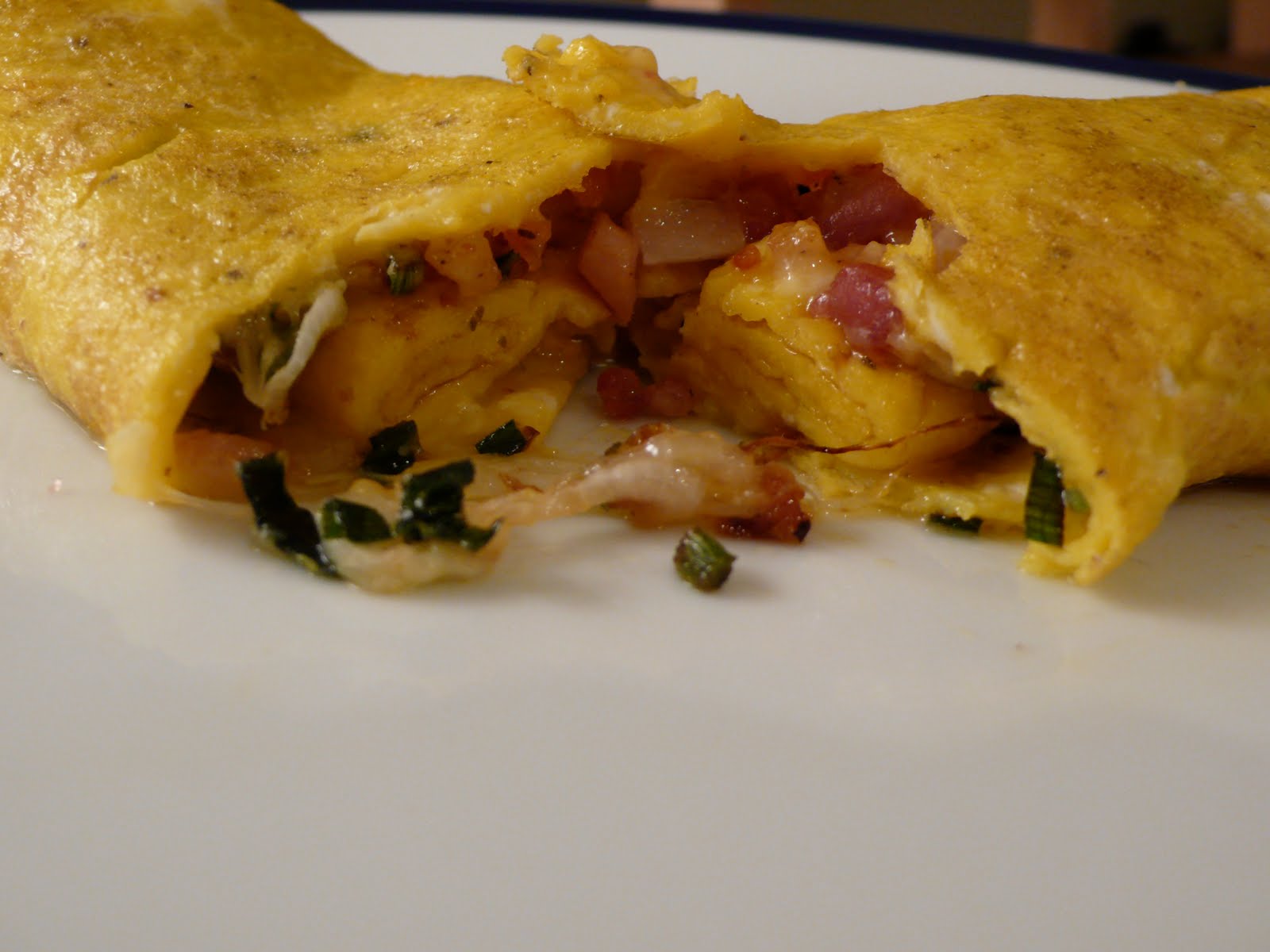
Dinner For 1: Cheddar, Spring Garlic & Pancetta Omelette Bliss

I just want to take a moment to draw your attention to how unbeatable an omelette is when you're cooking for one: it's super cheap, nutritious, quick, and easy, and magically transforms things like sad little nubs of cheese and random, wilty produce into a warm, gooey pocket of awesome.

Tonight, I used spring garlic (which is similar to scallions) from my weekly CSA delivery, along with leftover cheddar and pancetta. My omelette recipe can be found here. Add a cold beer, and dinner doesn't get much better than that.

Tuesday, May 11, 2010

I'll Bring Dessert.


I really don't know what keeps compelling me to volunteer to bring people dessert. I guess it just seems like the sporting thing to do when someone invites me to their house for dinner. Or lunch. Or cocktails. I'll bring dessert! It's a reflex. And no one ever seems to mind.

The thing is, I don't even really like baking, and it's always a much bigger time commitment than it should be to find the right recipe. I scour cookbooks, magazines, and websites, but almost everything I come across falls short based on one or more of the following deal-breakers:

-It's an all-day project, with 76 steps and requiring excursions around town for esoteric ingredients found at boutique chocolatiers or in the basements of Chinatown;
-It breaks the bank (see above re: chocolatiers);
-It's insufficiently impressive (oh ADMIT IT, if you're going to go to the trouble to make something from scratch you sure as shit aren't showing up with oatmeal raisin cookies);
-It requires fancy equipment like an immersion blender, kitchen torch, spring-form pan, parfait glasses, etc.;
-It relies on a seasonal ingredient that is not, in fact, currently in season;
-I would need to be a trained art handler to transport it in tact to its destination;
-It's meant to be served immediately out of the oven.

But after a lot of research and testing, I have come up with what I believe to be the ultimate go-to "I'll Bring Dessert" recipe: a baked lemon custard. It avoids all of the above pitfalls, and even happens to be reasonably healthy. The ingredients cost around $15, it takes me 30 minutes to prepare, and the only equipment needed is a hand mixer and a baking dish (I used an 8" souffle dish, but a square baking dish around that size would work too).


To give the dessert a seasonal touch I grab a garnish when I buy the rest of the ingredients -- recently I bought blackberries, mint, and whipping cream. You can improvise with different garnishes at different times of year: berries in the summer, dried fruits in the fall, shaved chocolate or chocolate sauce in the winter...you get the picture.

Baked Lemon Custard
Adapted from Bon Appétit, January 2006

Serves 6

3/4 cup sugar
3 tablespoons butter, room temperature
1 tablespoon grated lemon peel
4 large eggs, separated
3 tablespoons all purpose flour
1 cup buttermilk
1/4 cup lemon juice

1. Preheat oven to 350°F
2. Butter an 8" souffle dish, or similar ceramic baking dish.
3. Using electric mixer, beat sugar, butter, and lemon peel in large bowl; beat in egg yolks.
4. Mix in flour in three additions alternately with buttermilk in two additions. Stir in lemon juice.
5. Using clean dry beaters, beat egg whites in medium bowl until stiff peaks form.
6. Fold egg whites into yolk mixture; pour batter into baking dish.
7. Bake until custard is set in center and beginning to brown, about 35 minutes. Remove from oven and let cool.

Can be made 1 day ahead -- cool completely, cover, and refrigerate. Transport in souffle dish then invert onto plate to serve. Accept praise graciously.