Showing posts with label weeknight dinner. Show all posts

Tuesday, November 16, 2010

Cotes de Veau & Compromise

I am a dedicated meal planner. This will come as no surprise anyone who knows me, given that one of my most salient character traits is that I plan everything. My life can be more or less boiled down to a complex hierarchy of lists, ones that only I understand. Often my 'To Do' list will feature sub-lists as well as reminders to make other lists, a fact which is frightening and comic and tragic all at once.

So once a week --usually Thursday -- I sit down and look at the seven days ahead. I look at which nights I'll be at home and I plan what I'd like to cook. Sometimes I'll cruise through magazines and cookbooks for inspiration, sometimes I'll just get a load of vegetables and a protein and wing it.

The advantages of planning meals this way are manyfold: I can tackle all the food ordering for the week in one go (from Freshdirect, which means that I can do it from my desk instead of braving the yuppie mosh pit that is Wholefoods); it removes all day-to-day 'what are we doing for dinner tonight' anxiety; and it drastically reduces the number of sheepish takeout food orders made due to lack of creativity, energy, motivation.

The big downside: sometimes I get ahead of myself in these meal planning sessions, and my ambition wanes in between the actual planning and execution of said meals.

For instance, last night. There's a recipe in the November issue of Saveur for Braised Veal Breast with Artichokes. Now doesn't everything about that sound completely fantastic? I thought so too. No-brainer. Monday night dinner!

Unfortunately so preoccupied was I by the elegance and very French-ness of this dish that I lost site of the fact that, oh I don't know, I have a day job. The recipe involved straining and reducing a sauce, many different different pots and pans, a 2 hour braise. In my French culinary fantasy none of this would be an issue because I would turn on some jazz and uncork a bottle of Sancerre around 4 PM -- so that's right after my afternoon nap -- and then spend the rest of the evening tending to dinner in a leisurely yet perfectionist fashion.

In my actual life I arrived home at 7 PM, to an apartment that looked like it had been trashed by thugs, limping because I had worn shoes all day that were too small (but on such a good sale!) and my feet were now riddled with blisters. What I really, truly wanted to do was to stare into space for a couple hours, or at the very most watch cable and do my laundry in peace.

So what to do under these circumstances? When you have $35 worth of veal rib chops in your refrigerator and less than zero desire to do right by them?

I compromised. I did not leave the veal languishing in the fridge and dine on white wine and popcorn, as I had half a mind to do. But I did dispense with the fussy, lengthy recipe and looked for the simplest way to prepare the perishable ingredients that I had stocked.

So, I roasted a Delicata squash that I had hanging around. I prepped the artichoke hearts, tossed them in boiling water with half a lemon for 15 minutes, sliced them thin, and then sauteed them in a hot skillet with olive oil, salt, and pepper.

For the veal chops: I turned to Julia Child, who can always be counted on to give you a straightforward and reliable way to cook nearly any cut of meat. Her recommendation for cotes de veau was to brown them, then transfer them to the oven in a casserole dish with some shallots and white wine and let them cook for 20 minutes. The white wine braising liquid then gets heated on the stovetop and reduced down, with butter, a splash of stock, and salt and pepper added in at the end. I put a veal chop together on a plate with the artichokes and Delicata squash and ladled the sauce over the whole thing.

Monday, October 18, 2010

Recipe Edits: Campanelle with Sausage, Pumpkin, & Cavolo Nero


Pictured above is the pasta with pumpkin, sausage, and cavolo nero that I cooked for dinner last night. I dunno, it was okay. The Viking thought that it was phenomenal but I suspect that's just because he was long overdue for a home-cooked meal.

I was out of town at the end of last week and in that short amount of time, The Viking had already begun to go feral. When I returned to the apartment on Saturday I found the shards of a broken espresso cup strewn across the floor, peels, cores, and bones of various foodstuffs scattered about the dining area, and evidence of what I believe to be early attempts at toolmaking. All that was missing was the cave paintings. Maybe if I had stayed away an extra day.

Anyway, I think what my Early Man was responding to in last night's dinner was the flavor combination, which I agree was appetizing...but given a few small changes in execution, the dish could have excellent (not to mention easier). Raw squash/pumpkin is punishingly difficult to peel and dice; the sausage was overcooked and rubbery from sitting in the pan too long; the kale had a slippery, boiled quality most closely associated with seaweed; the whole thing was bound together in a watery broth that I could have been reduced down to better effect.

Most of the time we choose recipes because the ingredients sound good: sausage, pasta, cavelo nero, pumpkin. What's not to like? The actual flesh and bones of the recipe, though, may not be all that inspired. That's why it's always important to read fully through a recipe before beginning to cook, making substitutions or changes in technique as you see fit (or, looking for a new recipe using the same ingredients, if the whole thing just doesn't seem right). A recipe ought not to be the boss of you. It should just be a guideline, open to your changes and interpretations.

I'll use this recipe as an example. I'm not going to include the source, because I don't mean to pick on its creators - but here's how I might have done things differently, if I could do it over again.

Pasta with Pumpkin, Sausage, and Cavolo Nero

Kosher salt
1 lb. sweet Italian sausage, casings removed if using links
1 Tbs. olive oil (optional
1 medium yellow onion, chopped
3 cups 3/4-inch-diced peeled, seeded pumpkin 1 small pumpkin or butternut squash, halved
1/4 cup dry white wine
4 cloves garlic, minced
1 tsp. dried Marjorem a pinch nutmeg
1-1/2 cups lower-salt 3/4 c. chicken broth
10 oz. cavolo nero kale (aka Lacinato, black, or dinosaur kale), trimmed, ribs removed, leaves cut into 1-inch pieces
8 oz. dried campanelle pasta
1/2 cup grated Parmigiano-Reggiano; more for serving
Freshly ground black pepper

Their instructions:

Bring a large pot of well-salted water to a boil over high heat.

In a heavy-duty 12-inch skillet over medium heat, cook the sausage, breaking it up into small pieces with a wooden spoon, until mostly browned, 6 to 8 minutes.Push the sausage towards the edge of the skillet and add the olive oil if the center of the pan is dry (this will depend on the amount of fat in the sausage). Add the onion and cook until golden and the sausage is well browned, about 8 minutes. Stir in the pumpkin, wine, garlic, and marjoram and cook until the wine evaporates, 3 to 4 minutes. Add 3/4 cup of the broth and cook until the pumpkin is almost tender, about 8 minutes. Add the kale and the remaining 3/4 cup broth, cover, and cook until the pumpkin and kale are tender, about 4 minutes.

Meanwhile, cook the pasta in the boiling water according to package directions until al dente. Reserve 1/2 cup of the pasta water and then drain well. Add the pasta to the skillet with enough of the pasta water to coat the pasta and vegetables generously. Stir in the Parmigiano and season to taste with salt and pepper. Serve with additional Parmigiano.


My Instructions:

Preheat the oven to 375 degrees, and place pumpkin halves cut-side down in a baking dish. Cook for 30-45 minutes, until a knife can be inserted fairly easily into the pumpkin. Remove from the oven, cool, remove peel, and cut into 3/4 inch dice. Set aside.

Bring a large pot of well-salted water to a boil over high heat.

In a heavy-duty 12-inch skillet over medium heat, cook the sausage, breaking it up into small pieces with a wooden spoon, until well browned, 8 to 10 minutes. Remove sausage from pan with slotted spoon and set aside.

Add olive oil if the center of the pan is dry (this will depend on the amount of fat in the sausage). Add the onion and cook until golden, 6-8 minutes. Stir in kale, wine, garlic, nutmeg, salt, and pepper, and cook until the wine evaporates, 3 to 4 minutes. Add chicken broth, bring to a simmer, and cook until kale is tender and broth has reduced to half, about 4 minutes.

Meanwhile, cook the pasta in the boiling water according to package directions until al dente. Reserve 1/2 cup of the pasta water and then drain well. Add the pasta, pumpkin, and sausage to the skillet with enough of the pasta water to coat the pasta and vegetables generously. Stir in the Parmigiano and season to taste with salt and pepper. Serve with additional Parmigiano.

Thursday, September 9, 2010

Braised Fish. Yes, Braised.


Yesterday, I had the unpleasant experience of coming face to face with my fall calendar. It was not pretty.

What is on the calender: work events galore, meetings with people that I successfully avoided all summer, weekend travel, everyone's wedding, the safe assumption that I will mostly not get home from work at reasonable hours, and house guests that, quite understandably, would rather do just about anything than have a homemade meal on their trip to New York City.

What is not on the calendar: cooking; quiet moments for blogging.

Ahhh. So this must be what everyone else's schedule looks like.

For the next couple of months, I predict a shortage of posts about do-it-yourself kitchen nerdery (making your own ricotta, carbonating water at home) and a wealth of information about clever new ways to feed yourself when you wind up with no time, mental energy, ambition, nor creativity.

...which is an apt segue into last night's dinner.

The first step towards making last night's dinner was talking myself into actually cooking dinner at all, as opposed to ordering takeout or eating a meal consisting of slightly expired cheddar, a Corona Light, and chocolate chip cookies. It turned out to be the right decision. I made the full meal in under an hour (which included some faffing around with laundry, channel surfing, and the like) and here's what I cooked:


-Tomato salad with fennel and feta: A reminder that a quick dinner doesn't have to be unsightly. I sliced the fennel and tomatoes that came in my CSA box and topped them with leftover crumbled feta, olive oil, rice wine vinegar, salt, and pepper. I took two extra minutes to think about presentation and ended up with something that I might actually serve to guests.


-Braised arctic char with lemon rosemary vinaigrette: the marriage of two things you probably never think to do, namely 1) use a vinaigrette on a protein and 2) braise a fish. I highly recommend both. Somewhere along the line vinaigrettes got pigeon-holed into the salad category, but they are so, so much better than that. A vinaigrette can make a versatile sauce as well as a braising medium. How to do it: sear the fish skin side down in an oiled pan over medium heat for 3 minutes, take it out of the pan, add vinaigrette (a cup or less), replace the fish skin side up, and let it sit in the simmering vinaigrette for about three minutes. Keep spooning the liquid over the fish as it cooks. Last night I used lemon rosemary vinaigrette (minced lemon rind, minced rosemary, lemon juice, white wine vinegar, and olive oil) but any kind of vinaigrette will do. I hesitate to call this way of preparing fish "idiot proof," but it's as close as they come.

-Brown rice: Nothing fancy here, just simple brown rice with some salt and olive oil. Always keep brown rice on hand for just these types of occasions. It's healthy and heats up well the next day for leftovers.

Tuesday, August 10, 2010

No Ifs, Ands, Or Halibuts


Meet Exhibit A: the red snapper that I bought for dinner with my brother and his wife this past weekend. Unbeknownst to me at the time, red snapper populations are at very low levels due to overfishing and it's best not to eat them. Note Red's expression here: bored, annoyed, put-upon. Watching, judging. All this, and I haven't even done a terrible job at grilling him yet.

The trouble with eating is that almost anything you put in your mouth these days is problematic in one way or another. If the food isn't unhealthy (artery-hardening; cancer-causing; diabetes-inducing), it's unethically grown (cruelly raised; brutally slaughtered), grown or processed in an environmentally harmful way (water-intensive; petroleum-guzzling; toxic in its byproducts), or unsustainably hunted (devastating to wild populations).

After I read all of Michael Pollan's books last year, it appeared that in order to eat with a clean conscience I should stick to a diet of barnacles, forest weeds, pond scum, and wild fish.

Now, a few new books on fish and fishing have hit the shelves and spawned (pun intended) interesting reviews by the likes of Sam Sifton and Elizabeth Kolbert in the New York Times and New Yorker respectively. To make a long story short, it appears that wild fish are off the "safe" list too.

I recommend reading the reviews for the full story, but here's the summary version:

1. The history of commercial fishery is one of progressively working our way though various fish species once thought too numerous to be harmed, fishing them to the brink of extinction, and then moving on to the next one.

2. At the current time we've all but obliterated wild populations of most any fish you can think to eat -- this is surprising given that fish are one of few things which Americans are encouraged to eat more of.

3. Farmed fish isn't necessarily a solution, because farmed fish are fed wild fish (is this not mind-bogglingly backward?), and the farms themselves often pollute natural fish populations/habitats.
Unfortunately none of the authors goes so far as to suggest a solution to this sad state of affairs, they just leave you feeling like a nasty, awful, greedy person for eating fish.

But a little additional research revealed that there are certain species that you can eat with a relatively guilt-free conscience. The Monterrey Bay Aquarium puts out a pocket-size Seafood Watch Guide (in fact, a separate guide for each region of the USA) to make seafood buying decisions easy (or, as easy as they can be given that you still need to distinguish between US-farmed and Central America-farmed tilapia). They also have a handy iPhone app.


Consulting my regional Seafood Watch Guide revealed that one of the things that I am encouraged to eat is wild Pacific halibut. This brings me to Exhibit B: pictured above is last night's dinner, a 6 ounce portion of broiled wild halibut, served with a homemade organic zucchini salsa verde and roasted organic new potatoes.

I'm pretty sure that we got through the meal without committing any major moral offenses.

Furthermore, the zucchini salsa verde is from the August issue of Bon Appetit and is highly recommended -- you can find the recipe here.

Wednesday, July 14, 2010

Go Fish


Be honest: does fish scare you?

Because recently it's come to my attention that the majority of Americans are freaked out by the idea of cooking fish. In a meeting with the product development team from a national kitchen and home goods store, I was told that food items relating to fish preparation (spices, marinades, sauces, etc.) typically didn't sell well in their stores, which has led them to realize that their customers don't cook much fish at home. Later in the same week an editor at a large entertainment news weekly informed me that they do not print fish recipes as a matter of policy, having deemed fish to be inaccessible by their readership.

To me, this is bizarre and worrisome. You want to know what's actually difficult to cook well? Chicken. Lean cuts of pork. In fact, all leans cuts of all meat. You know what's easy? Fish.

I assume that you, my readers, represent a higher order of person than those scared off by our legless friends. But just in case any of you number among the fish-phobic, I'm here to help. Today I bring you a cheap, quick, easy - dare I say foolproof? - method for cooking fish.

Take the lowly tilapia. This does not number among my favorite fish. It sounds like a tropical disease and, cooked plain, it tastes of wet sock. As soon as it begins to cook, tilapia gets VERY flaky and begins to fall apart. Every time I have cooked it in a skillet it has come out the other end looking like a pile of mashed potatoes. I've never tried grilling it, but can assume that that's a non-starter.

HOWEVER...tilapia is cheap, one of the most environmentally sustainable fish out there, and very low in fat and calories, so we should stop being such snobs and learn how to cook it properly. Let's focus on the positive, shall we?


Think of tilapia as the fish equivalent of tofu: it may not have a lot of flavor on its own, but it soaks up the flavors around it. When cooked with the right mix of pungent ingredients, it can really be lovely.

Here is how I recommend you prepare it: wrap it in a tin foil pouch with assorted flavorful things and stick it under the broiler for 20-30 minutes. This creates hassle-free, flavor-packed steamed fish with very minimal cleanup (just ball up the tin foil and throw it away). It also pretty much eliminates any wafting fish odors that threaten to weasel their way into your carpets and fabrics, which is always a consideration when pan-roasting fish.


I made tilapia this way last night, and have included below a recipe for the preparation I used. I've named it Tilapia Marseillaise, since the ingredients I used were a mix of Provencal and North African flavors, ones that you generally find in the cuisine of Marseilles (think Bouillabaisse). Also, today is Bastille Day, so I felt that I should nod in the direction of France. Ergo, Tilapia Marseillaise.

But get creative here, people; no need to use the same ingredients as I did. This is an opportunity to comb through your refrigerator and cupboards and experiment. You will be amazed at how exciting it is when you successfully cook something that you thought up all by yourself. The only guideline here is to include strong herbs and/or spices (mine were a Moroccan spice blend called ras el hanout and saffron).


Tilapia Marseillaise
Serves 2

2 6-8 oz tilapia fillets
1.5 cups chopped tomatoes
2 pinches saffron
1 Tbsp. ras el hanout
1/2 lemon
1/4 cup olive oil
1 Tbsp. fresh thyme leaves
6 sprigs thyme
2 cloves garlic, halved and crushed
2 large sheets tin foil

1. Place each fillet on its own sheet of tin foil, and sprinkle them with salt, pepper, ras el hanout, and saffron.
2. Squeeze lemon onto the fillets, coat with them olive oil, and place thyme, garlic, and tomatoes on top.
3. Wrap the tin foil sheets into pouches (folding the short ends inwards, and then rolling the long ends together like the top of a lunch bag).
4. Place them directly under broiler, seam side up, and let cook 20 - 30 minutes.
5. Unwrap and transfer to plates.

Wednesday, June 30, 2010

Qu'est-ce Que C'est Dans Ma Boite Du CSA? Cherries, Greens, Lettuces, Garlics, Beets, & Spring Red Onions


This past week has been one particularly full of upsets and surprises in the world of sports. In the World Cup, England didn't make it past the Round of 16, having been asked by zie Germans on Sunday to pack up their three-piece suits and go home. Over at Wimbledon, two little-known men stretched their first round match to over 11 hours and almost 180 games; one of those leggy blonde Russian model-slash-tennis-players vanquished Venus Williams in the quarterfinals; and just a few hours ago, a person I have never even heard of dissed and dismissed Roger Federer in four sets.

Likewise, this past week I astounded myself (and maybe The Viking a little bit too) by using everything that the CSA man delivered to me last Tuesday night -- despite many dinners out, despite too much work, despite utter weariness of Swiss chard, which has begun to haunt me in my dreams. Would I call this an athletic feat? Probably not. But getting all those fruits and vegetables into food form in a seven day period took intense concentration, discipline, and training. The results weren't always pretty, but I got the job done.

[Ed Note: If you think that this sports analogy was an awkward and terrible way to begin a blog post mostly about beets and leafy greens, you are correct. I just really wanted to mention that FEDERER LOST to some rando! In 4 sets! What's up with the world?!]

I don't have a lot of time to elaborate today, but I did want to give a brief recap of where this week's produce went (with promises to be more entertaining tomorrow):

We got exactly five beets in this week's CSA delivery, none of which were larger than a lime. I turned them into an appetizer for Monday night's dinner (a two course dinner on a weeknight = a rarity, by the way). I wrapped the beets in tin foil and roasted them at 375 for half an hour, then let them cool, peeled the skins off, and sliced them thin. I topped that with shards of cold Crottin goat cheese, a drizzle of balsamic vinegar and walnut oil, and a sprinkling of chopped basil, kosher salt, and pepper. The outcome was terrific, and I plan on making this again when we have company (and a more sizeable delivery of beets).


Of the cherries that look so gorgeous up above, most went directly into The Viking's mouth, who spat their pits into a bowl like machine gun fire. The cherries that I could rescue from his gaping maw became that sad clafouti that I told you about.

Some of the Swiss chard went into my lunches this week. But I find that no matter how much Swiss chard you use, the next time you open your fridge the same amount seems to be waiting for you. Luckily all of this pressure to use leafy greens has taught me a thing or two about disposing of large quantities of them (and spring onions and garlic, too). Just chop them all up and saute them! Really, I cooked Swiss chard, kale, and beet greens according to the method described here, adding a splash of white wine vinegar at the end to give them a little tang. They wilt down to almost nothing, and I served them with roast pork and new potatoes.


And finally the lettuces. Lettuces tend to speak for themselves. I ripped them up and dressed them with a vinaigrette of garlic scapes, Dijon mustard, white wine vinegar, and olive oil, and served them with roasted new potatoes and broiled sockeye salmon.

Wednesday, June 23, 2010

Qu'est Que C'est Dans Ma Boite Du CSA? Kale, Swiss Chard, Lettuces, Radishes, Carrots, Spring Garlic, & Garlic Scapes

Another Wednesday, another batch of sad vegetables languishing in my crisper drawer. I didn't get a chance to do much cooking these past days (too much World Cup, too many Real Housewives reruns, too little culinary ambition), and as a result was again unable to make the most of my CSA delivery. Whimper.

I'm becoming slightly worried that this CSA produce is going to function much in the same way as my New Yorker subscription, which exists to sit around the house and make me feel bad about myself, reminding me of the person that I could be: someone who reads contemporary short fiction and doesn't let good food go to waste.

But, let's start with the high points.

Kale and carrots went into this gorgeous white bean & kale soup. It's Dan Barber's recipe (courtesy of Bon Appetit, available here), and I have to say that it seemed suspiciously healthy when I first encountered it. I worried that it might turn out to be one of those things that personal trainers and trophy wives eat and rave about but that really tastes like sawdust mixed with dishwater.


It does not. It's tangy and light and delicious. The key here is the Sherry vinegar added in at the end -- if you don't have Sherry vinegar on hand, do not skip this step. You can use white wine vinegar instead. Also, make sure to give the stock and white wine plenty of time to reduce down to make a concentrated broth, even if you exceed the timing marked in the recipe.

The Viking and I ate the soup with some disappointing store bought bread. The whole meal happened to be vegan, for those of you who go in for that sort of thing. For those that don't: I'd suggest frying bacon or pancetta in with the shallots at the beginning for a heartier soup.

The next night, I made a pasta dish from the Swiss chard, garlic scapes, and spring garlic, and served it with with pork cutlets in a cider-mustard sauce.


For the pasta dish, I separated the leaves and stems of the Swiss chard, chopping them separately. Then I sliced and sauteed garlic scapes and spring garlic (white parts only) in olive oil. I added in the sliced stems and a little water, letting them soften and then adding the leaves and little bit more water. Then I added almost 2 cups of chopped San Marzano tomatoes. That all got mixed together with a pound of penne and 1/2 cup Parmesan. As a side note, do yourself a favor and buy high quality pasta -- something other than Ronzoni, De Cecco, and Barilla if you can find it. It has more texture and flavor, and really makes all the difference.

I digress. I suppose I shouldn't spend any more effort trying to distract you from the issue at hand, which is of course the big bag of lettuces and radishes left in my fridge. I briefly considered eating a side salad with my double espresso this morning, but ultimately decided against it. They're still sitting in the fridge wilting right now, probably wishing that they were delivered to someone who really appreciated them.

Thursday, June 10, 2010

Dinner For 1: Cheddar, Spring Garlic & Pancetta Omelette Bliss

I just want to take a moment to draw your attention to how unbeatable an omelette is when you're cooking for one: it's super cheap, nutritious, quick, and easy, and magically transforms things like sad little nubs of cheese and random, wilty produce into a warm, gooey pocket of awesome.

Tonight, I used spring garlic (which is similar to scallions) from my weekly CSA delivery, along with leftover cheddar and pancetta. My omelette recipe can be found here. Add a cold beer, and dinner doesn't get much better than that.

Wednesday, May 19, 2010

Take A Chance On Farro


The Viking absolutely loves his cured meats. If left to his own devices he'll eat prosciutto, speck, sopressata, and bresaola by the fistful, munching a saucisson down to the nub for an encore. Watching him return from a Saturday morning bike ride and set upon a few containers of the stuff is really a site to see. He can slurp slices of it down almost like oysters, alternating sheets of cured meat with gulps of a double espresso, barely even stopping to chew. It's like watching a python devour its prey.

And, like the python owner dutifully visiting the pet store for a fresh supply of white mice, so too do I traipse up to the salumi shop every so often to replenish The Viking's cache of cured meats (to be fair, I eat and like them too, they just don't have quite the same primal hold over me that they do him).

Our favorite place to go is Salumeria Rosi on the Upper West Side, which in addition to being a primo source of meats and cheeses is also a damned fine little restaurant. The shop has about 15 seats and a shoe-box of a kitchen from which Cesare Casella, its chef and owner, serves a limited menu of Northern Italian dishes.

We washed up at the Salumeria at the end of last week feeling the way one does on a Friday evening: world-weary and badly in need of a glass of wine. We ordered some of our usual dishes, cavoloni con prosciutto, insalata pontormo, manzo di lucca, but my favorite thing that night was a special -- farro with asparagus, basil, and parsley. It struck that rare and precious balance of feeling indulgent and comforting without being heavy. The flavors were fresh and grassy, the firm grains of farro and taute little disks of asparagus held together in a lightly creamy, cheesy sauce.


Best of all, it seemed like something that I could reasonably expect to recreate at home. I tried to do exactly that on Monday night and served the finished product alongside sea bass. Mine was significantly less creamy (in retrospect I could have cooked the farro risotto-style rather than simmering it in water, which would have helped the creamy factor) but the flavors were there. It not only made a great side dish that night, but we had loads of leftovers that have reheated well for lunches. This whole week I can't help but think about just how wildly underappreciated farro really is: it's like barley only better, yet it has been relegated to second class citizenship while brown rice and quinoa inexplicably get all the attention. If you see farro while you're out shopping (you might have some luck at your local Wholefoods), pick it up and give it a try.


Farro with Asparagus, Basil, and Parsley
Inspired by Salumeria Rosi

Serves 6

1 large or two small shallots, minced
1 bunch asparagus
1 tbsp chopped parsley
3 tbsp chopped basil
3 tbsp butter
1/2 c olive oil
1 lb farro
2 c grated Parmesan

1. Soak farro in cold water and let sit for 25 minutes.
2. Meanwhile, trim and peel asparagus, then thinly slice into 1/8" rounds
3. Drain farro, then transfer to large pot with 2 quarts water; bring to boil, then reduce heat and let simmer for 25 minutes.
4. Heat butter in large skillet over medium heat until it foams.
5. Add shallots and let soften, 2-3 minutes.
6. Add asparagus, kosher salt, and pepper, stir to coat, and cook for 3 minutes more; remove from heat (asparagus should still have some bite).
8. Drain farro then add in olive oil, Parmesan, asparagus, and herbs; add salt and pepper to taste.

Thursday, May 13, 2010

Are You There Eyjafjallajokull? It's Me, Liz


At the moment, I find myself in the somewhat awkward and primitive position of praying to a volcano. I imagine that people have been doing this in Iceland for a thousand years, although for the most part it has probably involved virgin sacrifice and an entreaty to spare flocks of sheep from a sea of molten lava. Well I don't have any virgins to offer, but all I want is for the volcano to leave my vaca alone.

In exactly one week, I am scheduled to travel via London to Morocco for ten days of pure enjoyment. I have been looking forward to this for months. In some sense I have been looking forward to it since November 31, 2007, when I returned from Argentina -- that was the last time that I took a whole week off from work and ventured somewhere new in the world.

Here's the plan: three days in the UK for a full-throttle English wedding, four days trekking in Morocco's Atlas mountains, and then three days in Marrekech to spend at spice markets and souks, getting hammam treatments, eating street food, and sunbathing. Yeah, so it's a pretty nice vacation that we lined up for ourselves.

Unfortunately, as I write this, there's a big, angry plume of volcanic ash drifting around up there, and whether or not my trip actually happens depends -- literally -- on which way the wind blows and how long the erruption lasts. The only ash cloud I've ever worried about up until now is the one circling my head when I'm trying to sneak a cigarette, but I've become obsessed with this thing: tracking its movements, researching prevailing seasonal wind patterns, checking up on airport-by-airport flight disruptions.

Everyone keeps reminding me that there's nothing I can do about it, so I might as well just relax. "Relax" isn't in my vocabulary, but it translates most closely to "make a stew."

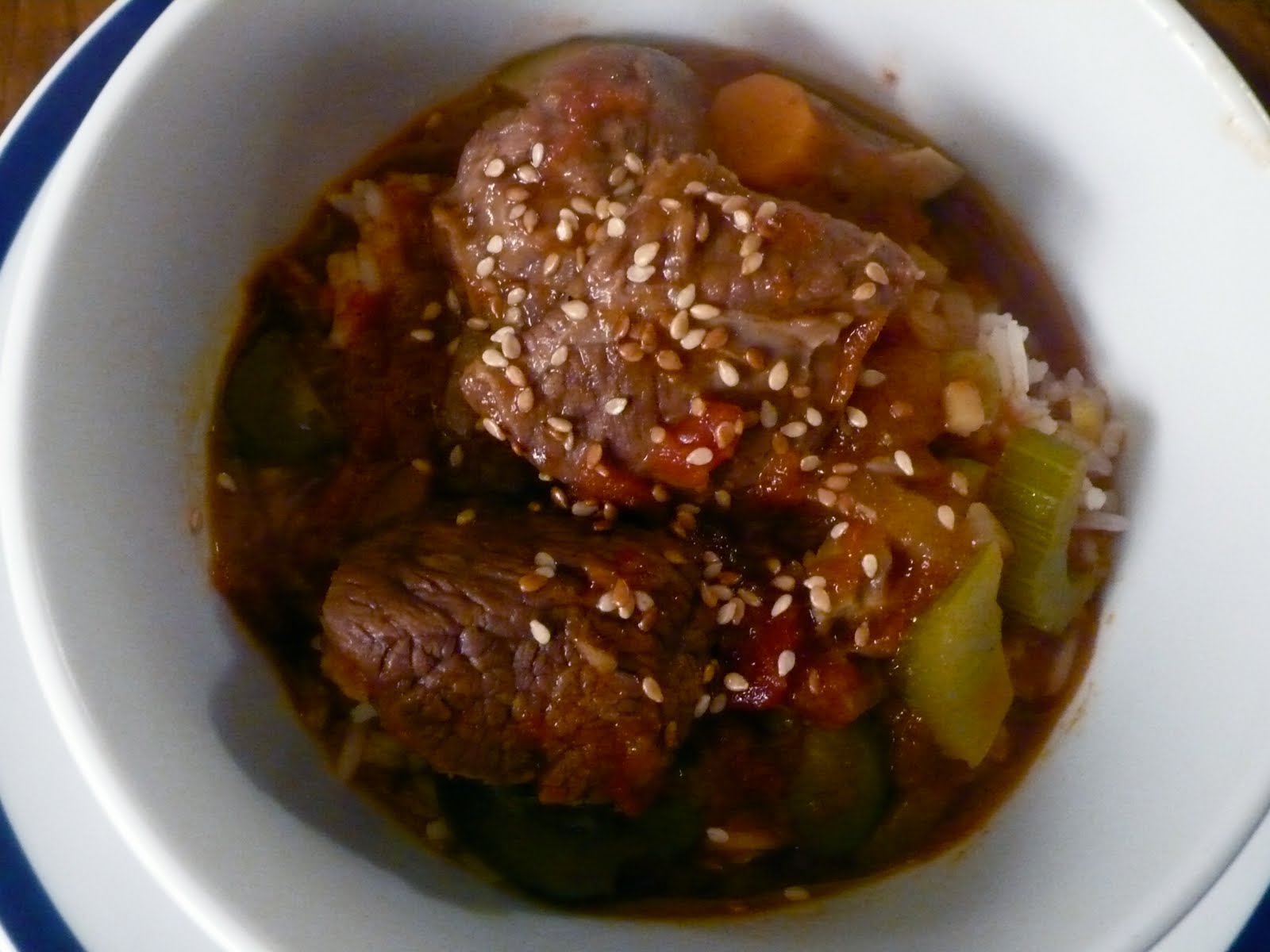
In honor of the (hopefully) impending trip, I decided to make a tagine.

A tagine is a Morrocan stew (as well as the name of the vessel that you use to cook it in). There are countless variations, but they tend to feature a handful of the following: olives, apricots, apples, raisins, dates, almonds, fresh or preserved lemons, orange, lamb, chicken, honey, and spices including cinnamon, saffron, ginger, turmeric, cumin, paprika, and/or the King of all North African spice blends, Ras El Hanout.


I absolutely love a good stew: they're warm, comforting, filling, and fun to make. A stew is just enough work to make you feel like you've accomplished something but not enough to make you regret starting it in the first place. Here's the general formula:

-Chopping things, like meat, celery, carrots, onions;
-Browning meat on the stovetop (a critical step for anything that's going to cook slowly in liquid
it gives the meat that rich roasted flavor);
-Dumping liquids and spices into a pot, cracking open a bottle of wine, and giving the simmering mixture an occassional stir, sniff, and taste.


Once your stew is done, you have a one-pot meal with loads of leftovers that will taste even better in a day or two once the flavors have had a chance to meld. Stews also freeze beautifully, especially if you put them away the same night they're made.

I got this particular tagine recipe from the New York Times and found it to be flavorful, lean, and easy to prepare. It does require buying lots of spices, especially if you don't have a good collection to start with, but once you have those on hand your second, third, and fourth tagine will be dramatically less pricey to buy for. In terms of equipment: I don't have an actual tagine (in a New York City apartment? Please.), but an enameled cast-iron pot works just as well. If you don't have that, then an oven-proof 5 quart pot will fit the bill.

If Eyjafjallajokull cooperates, hopefully this will be the first of many Morrocan-themed posts to come. Keep your fingers crossed.


Lamb Tagine With Green Olives

From The New York Times, April 5 2010

Serves 4

For the spice mixture:
3/4 teaspoon ground coriander
1/2 teaspoon ground cumin
1/8 teaspoon cinnamon
1/2 teaspoon paprika
Generous pinch cayenne
Pinch saffron

For the tagine:
1/4 cup extra-virgin olive oil
2 pounds lamb stew meat, cut into chunks
1/2 teaspoon salt
1/4 teaspoon pepper
1 medium onion, sliced into medium-width pieces (about 1 cup)
1 clove garlic, peeled
1 tablespoon diced, fresh ginger (from about 1 inch)
Juice of 1 orange
1 14-ounce can diced or chopped tomatoes
1 2-inch-long piece of orange peel
2 cups chicken broth
1 teaspoon honey
1 medium carrot, sliced ½-inch thick (about 1 cup)
1 celery rib, sliced ½-inch thick (about 1 cup)
1/4 cup sliced almonds
1½ tablespoons sesame seeds 8 green olives, sliced into quarters (about 1/4 cup)

For the citrus rice:
1½ cups basmati rice, rinsed 3 times
1 bay leaf, preferably fresh
Grated zest of 1 lemon
Pinch of salt
1/4 teaspoon red-pepper flakes
1 tablespoon unsalted butter
Juice of 1 lemon
1 orange, sectioned and chopped (about ¼ cup)
2 scallions, sliced

1. Make the spice mixture by stirring together the spices in a small bowl. Preheat the oven to 350 degrees.
2. In a large, ovenproof stew pot or tagine, heat the oil over medium-high heat. Season the lamb all over with salt and pepper. Add the meat to the pot and stir to coat in the oil. Brown for about 5 minutes, stirring occasionally to make sure the meat browns evenly on all sides. Transfer the meat to a bowl and set it aside.
3. Lower the heat to medium and add the onion, stirring to coat. Sauté for about a minute, until it begins to soften. Add the garlic and ginger and add the meat back to the pot. Stir everything together. Squeeze the orange juice into the pot and mix well. Add the tomatoes, orange peel, spice mixture, chicken broth and honey. Mix well. Raise the heat to medium-high and bring the mixture to a simmer, then cover the pot and put it in the oven. Cook for 1 hour or until the meat is about half-cooked.
4. Stir in the carrots and celery and return the pot to the oven. Cook for another 30 to 45 minutes, until the sauce is thick and reduced and the lamb is tender.
5. While the tagine is in the oven, toast the almonds and the sesame seeds in a small pan over low heat until the nuts are golden, about 5 minutes, stirring regularly to make sure the almonds don’t burn.
6. About 15 minutes before the tagine is finished, make the citrus rice: Put the rice and 2 cups of water in a large pot set over high heat. Add the bay leaf, lemon zest, salt, red-pepper flakes and butter. When the water boils, lower the heat and cover the pot with a tight-fitting lid. Continue to simmer until the liquid has been absorbed, about 12 minutes. Turn off the heat. Add the lemon juice, orange pieces and scallions and mix well. Transfer to a large bowl and serve immediately.
7. Remove the garlic clove and orange peel from the tagine. Add the olives and spoon the tagine onto a large serving plate. Sprinkle the almonds and sesame seeds on top. Serve immediately, with citrus rice.

Tuesday, April 13, 2010

Salt-Roasted Salmon Is My Everest


"Never confuse a single defeat with a final defeat." //F. Scott Fitzgerald//

To me, one of the most exciting things about cooking is screwing up. Not "I added salt instead of sugar because I was preoccupied with watching Hoarders" type screwing up, but when something by all accounts should taste damned yummy and decidedly does not. I love a good puzzle, and figuring out how to make the alchemy that is cooking work in my favor is exactly that.

I mention this because of a particularly puzzling recent kitchen fail. The dish was out of Tom Colicchio's first cookbook, Think Like A Chef, and like most very short recipes it was deceptively difficult to pull off. The promise: sear fillets of salmon skin-side down in pan; bury in coarse sea salt and put in oven; remove from oven, brush away salt, and voila! Perfect medium-rare salmon.

Never mind the logistics of coating a wet thing in salt and then removing it again. Salt-roasted! Doesn't that sound like a Nantucket clam bake in your mouth? Wouldn't it be the slickest party trick when I unearthed the salmon from its mound of salt table-side, expertly, effortlessly, Kitchen Goddess That I Am?

Alas, my first try at salt-roasted salmon turned out to be truly inedible. It came out something like cat food rolled in iodine, the most catastrophic result I had had since The Pumpkin Soup Incident Of '06 (a story for another day). This would have been embarrassing were my only guest not the long-suffering Viking, who looked sidelong at the salt-studded little brick of fish and gamely took the first bite.

Right. Crackers and cheese for dinner.

Truth be told I don't even like salmon all that much. Or Nantucket. Or clam bakes. But pride makes us do stupid things, and so I persevered with the recipe. A day may come when I am defeated by a small fish, but it would not be this day.

I won't bore you with tales of subsequent flops -- suffice it to say that I have instilled in the Viking what might be a permanent phobia of big red canisters of La Baleine sea salt ("Maybe it wasn't meant to be," he philosophized after my third attempt, as we stared wanly at our sad, pink little salt licks).

Okay, so the first time around I didn't exactly follow the timing as indicated, so being more diligent there solved the overcooking issue. Removing the salt continued to be a stumbling block. I tried different types of salmon and various ways of removing the salt (paper towel, pastry brush, bare fingers, tweezers, prayer...), but found that even a few granules of the pernicious stuff was enough to ruin the fish. Finally I gave up and put parchment paper between the salt and the fish, which turned out to be the winning (if inelegant) solution for some seriously tasty salmon.

On my final attempt I served the salt-roasted salmon alongside brown rice and a simple watercress and fennel salad with lemon-rosemary vinaigrette (pictured above). The entire meal took only an hour.

Six nights and one hour.


Salt-Roasted Salmon
Adapted from Tom Colicchio's Think Like A Chef

Serves 2

2 six ounce center cut salmon fillets (high-quality farmed or never-frozen wild)
3 cups course sea salt
2 tablespoons olive oil
Kosher salt
Freshly ground black pepper


1. Preheat oven to 400 degrees F.

2. Heat olive oil in oven-proof skillet over medium-high heat for around 1 minute.

3. Add salmon fillets and cook for 2-3 minutes, until skin is crisp.

4. Remove skillet from heat and cover each salmon fillet in 1 layer of parchment paper.

4. Pour sea salt over fish, fully covering all fillets.

5. Move skillet to oven and roast for 6 minutes.

6. Remove salmon fillets from skillet with spatula one at a time, taking care to brush away any salt granules stuck to the bottom.

7. Drizzle with olive oil, season with pepper and salt, and serve immediately.